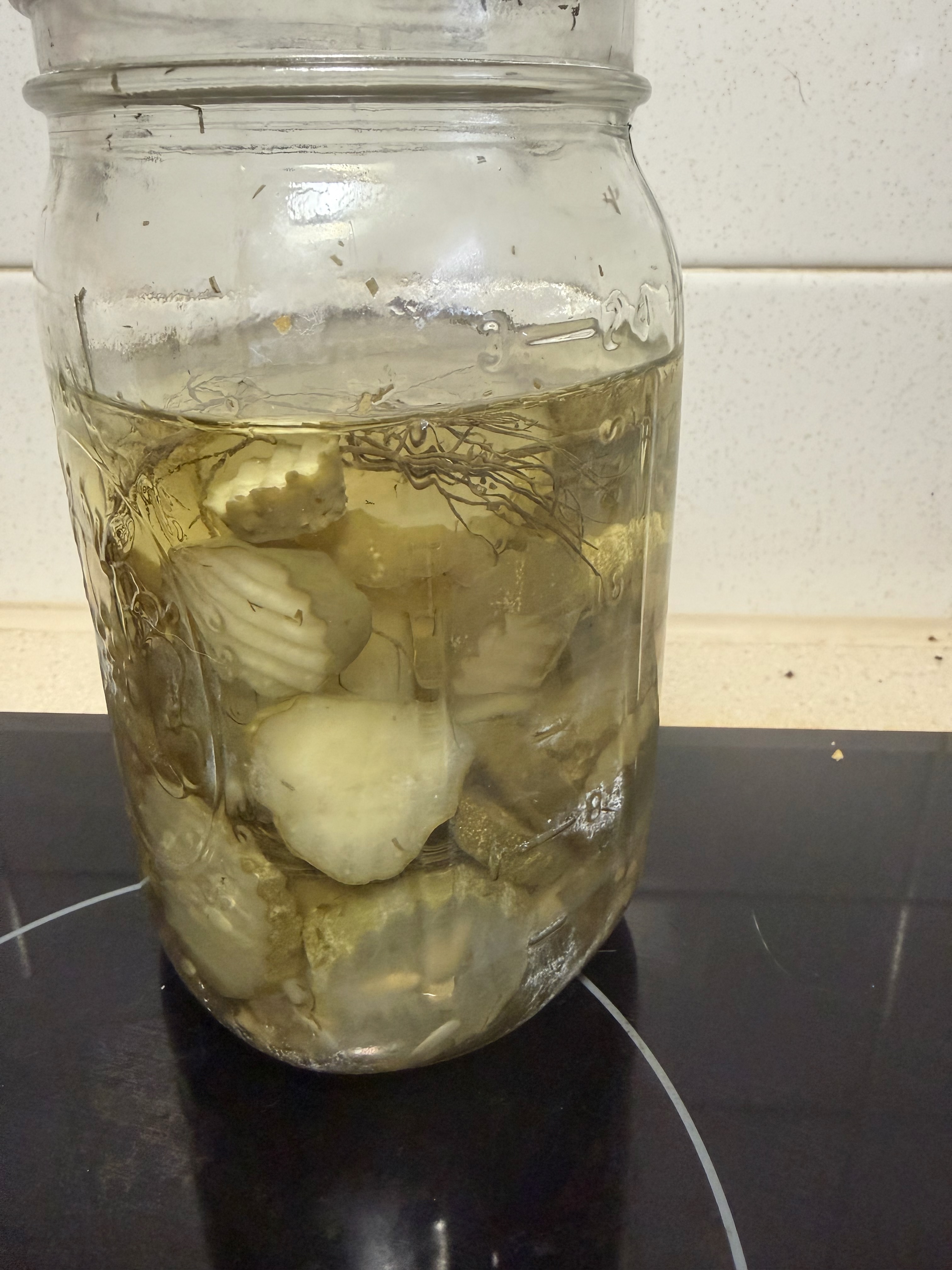
Skip the canner entirely—turn a garden cucumber glut into crisp, tangy pickles with 15 minutes of prep and a night in the fridge.
The Story
This recipe came to us from Mary Ann, and it’s one of those “why didn’t I know about this sooner” recipes. No water bath canner. No sterilizing jars for twenty minutes. No standing over a hot stove processing anything. Just cucumbers, onion, a stirred-together brine, and a container in the fridge. Twenty-four hours later, you have pickles.
I grew up thinking pickles meant canning day—hauling out the big pot, sterilizing jars, timing the boil, sweating through August in a kitchen that felt like a sauna. Mary Ann’s recipe upended all of that. It turns out you don’t need any of it if what you want is pickles for the fridge instead of pickles for the pantry shelf. The trade-off is simple: these won’t sit shelf-stable for years like a properly canned pickle. But they’ll keep in the refrigerator for up to a year, and most of ours never last that long anyway.
What sold me on this recipe, beyond the ease, is what it does for a garden cucumber glut. Anyone who’s grown cucumbers knows the feeling—you check the vines on Monday and there’s nothing, you check again on Thursday and suddenly you’re holding six of them and wondering what on earth you’re going to do with all of them before they go soft. This recipe is the answer. Eight cups of sliced cucumbers disappear into one bowl, one brine, one container. No fuss, no wasted harvest.
I also love how forgiving it is. Mary Ann’s base recipe is simple—vinegar, sugar, salt, celery seed—but it’s really a template. Add dill and garlic, and you’ve got dill pickles. Add red pepper flakes, and you’ve got something with a kick. It’s the kind of recipe that becomes different pickles depending on what’s in your spice cabinet that week, and I like that a single afternoon in the kitchen can produce three or four different jars, each a little different, all from the same base.
Key Details
Prep Time: 15 minutes | Chill Time: 24 hours minimum | Total Time: 24 hours 15 minutes | Yield: About 2 quarts
Sustainability Note: No canner, no burner running for a processing cycle, no propane or electricity spent beyond a few minutes of stirring—this is one of the lowest-energy ways to preserve a cucumber harvest. It’s also a direct answer to garden waste: instead of letting an overflow of cucumbers go soft on the counter, you turn the whole glut into something that keeps for months, with nothing composted that didn’t need to be.
The Recipe
Ingredients
| Amount | Ingredient |
|---|---|
| 8 cups | Cucumbers, sliced |
| 1 large | Onion, sliced |
| 1 cup | White vinegar |
| 2 cups | Sugar |
| 2 tbsp | Canning salt (or kosher salt) |
| 1 tsp | Celery seed |
Optional additions: garlic cloves, fresh dill sprigs, dill seed, mustard seed, red pepper flakes, pickling spice
Instructions
-
Slice the vegetables: Slice cucumbers about 1/4-inch thick and slice the onion thin. Place both in a glass or plastic container—avoid metal, which can react with the vinegar brine.
-
Mix the brine: In a bowl, combine the vinegar, sugar, canning salt, and celery seed. Stir until the sugar and salt fully dissolve. For crisper pickles, bring the brine to a boil first, then let it cool slightly before pouring.
-
Combine: Pour the brine over the cucumbers and onion. Add any optional seasonings you’re using—garlic, dill, mustard seed, red pepper flakes. Stir to make sure everything is evenly coated.
-
Chill: Refrigerate for at least 24 hours before eating. The flavor keeps deepening over the following days, so don’t rush it.
-
Store: Keep refrigerated. These will hold for up to a year in the fridge.
Why This Recipe
A direct answer to the cucumber glut. If you’ve ever grown cucumbers, you know they don’t trickle in—they arrive all at once. This recipe absorbs eight cups in a single batch, which is usually enough to make a real dent in a harvest that would otherwise go soft on the counter before you got around to it.
No canning equipment, no canning energy. There’s no water bath canner, no sterilizing jars, no processing time, no standing over a hot burner for half an hour. The only energy involved is a few minutes of stirring and, if you choose, briefly heating the brine. On a hot summer day when the last thing you want is a pot boiling for twenty minutes, that matters.
Reduces food waste without a big time commitment. Fifteen minutes of prep is nothing compared to a full canning session. That low barrier means you’re actually likely to use up the cucumbers before they turn, instead of letting “I’ll get to it” become “well, those are compost now.”
Pantry economics that make sense. Vinegar, sugar, and salt are cheap, shelf-stable staples you likely already have on hand. Compare that to what a jar of specialty pickles costs at the store, and a batch of these—made from cucumbers you grew yourself—is about as good a return as preserving gets.
Notes & Variations
- Cucumber choice: Pickling (Kirby) cucumbers give the crispest results, but any fresh cucumber works fine—just expect a slightly softer bite from standard slicing cucumbers.
- Hot vs. cold brine: Bringing the brine to a boil before pouring it over the cucumbers gives a crisper pickle. A cold-mixed brine works too—it’s just a matter of texture preference, and both are tested and reliable.
- Less sweet version: Reduce the sugar to 1 to 1.5 cups if you prefer a more tart pickle. Tested and works well.
- Salt matters: Use canning or kosher salt, not iodized table salt—iodine and anti-caking agents can cloud the brine and dull the flavor.
- Dill Pickles: Add fresh dill sprigs or dill seed plus a few garlic cloves to the brine.
- Spicy Pickles: Add red pepper flakes, or slip in a few sliced jalapeños.
- Bread & Butter Pickles: Add mustard seed, a pinch of turmeric, and a bit of fresh ginger.
- Garlic Pickles: Add extra garlic cloves and a few whole peppercorns.
Gluten-Free Notes:
- This recipe is naturally gluten-free as written. No modifications needed.
Additional notes from our kitchen:
- No canner required, but no shelf life either. These are refrigerator pickles, not shelf-stable canned pickles. They must stay cold the entire time—there’s no processing step that makes them safe at room temperature.
- Batch it up. This recipe scales easily. When the cucumber vines are producing faster than we can eat, I’ll mix a double batch of brine and fill two or three containers at once, each with a different add-in.
- Onion softens fast. The onion picks up flavor quickly and softens nicely alongside the cucumbers—don’t skip it even if pickled onion isn’t usually your thing.
Serving Suggestions
- Piled onto sandwiches and burgers
- Served alongside deli meats and cheese on a snack board
- Chopped into potato salad or tuna salad
- Straight out of the jar, standing at the fridge
Storage & Make-Ahead
- Refrigerate only: These are not shelf-stable and must stay refrigerated at all times—there’s no water bath processing step to make them pantry-safe.
- Shelf life: Keeps up to one year in the refrigerator.
- Make-ahead friendly: Flavor keeps improving for the first several days after mixing, so this is a great one to make ahead of a cookout or gathering.
Links & References
- Source: Seely Family Recipe Collection (from Mary Ann)
- Related: Grandma Norma’s Beet Pickles | Homemade Bone Broth | Hot Artichoke Dip
Print This Recipe
Click here to print this recipe or use your browser’s print function (Cmd+P on Mac, Ctrl+P on Windows).
Refrigerator Pickles Prep: 15 min | Chill: 24 hours minimum | Yield: About 2 quarts
Ingredients:
- 8 cups cucumbers, sliced
- 1 large onion, sliced
- 1 cup white vinegar
- 2 cups sugar
- 2 tbsp canning salt (or kosher salt)
- 1 tsp celery seed
- Optional: garlic, fresh dill, dill seed, mustard seed, red pepper flakes, pickling spice
Instructions:
- Slice cucumbers and onion; place in a glass or plastic (not metal) container.
- Mix vinegar, sugar, canning salt, and celery seed until dissolved (boil first for crisper pickles).
- Pour brine over cucumbers and onion, add any optional seasonings, and stir to coat.
- Refrigerate at least 24 hours before eating.
- Keep refrigerated—not shelf-stable.
Storage: Refrigerate up to one year. Not suitable for pantry storage.
Sometimes the most sustainable preserving trick isn’t a fancier technique—it’s realizing you didn’t need the canner in the first place.