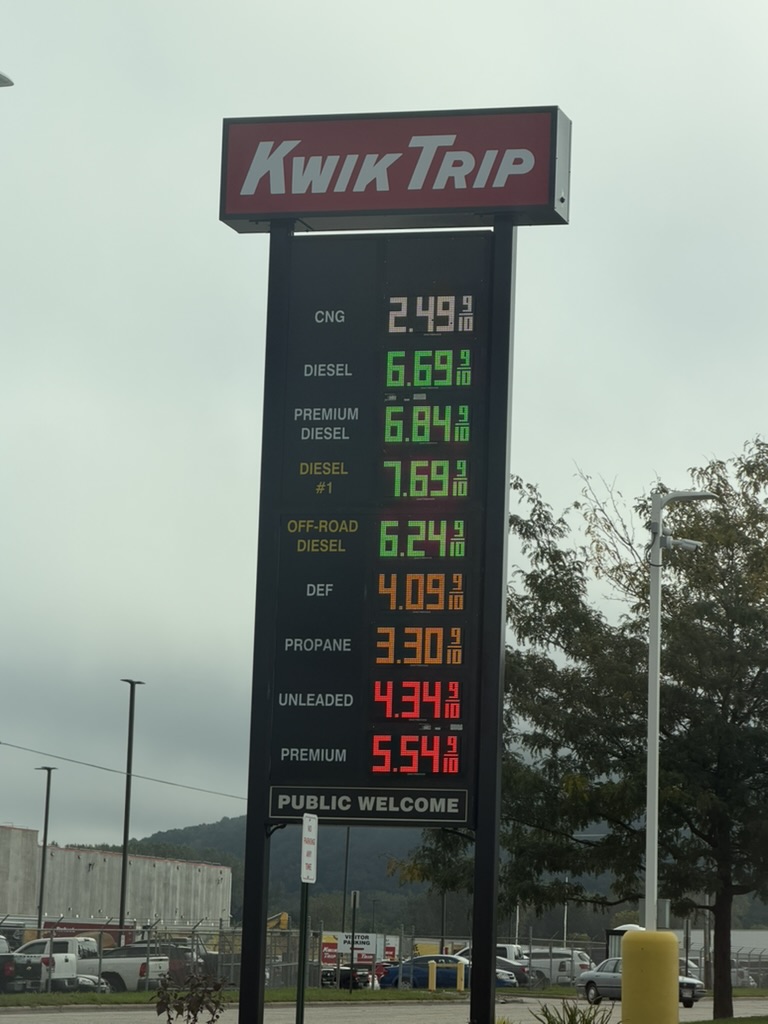
 The gas station at Kwik Trip’s La Crosse, WI campus — where I work — September 23, 2026.
I snapped this photo at work this week — unleaded at $4.34 9/10 a gallon on the sign at Kwik Trip’s La Crosse campus. Diesel was worse, at $6.69. Even a year ago that number would have made me wince. Now it makes our payback math look better.
That’s not a typo. When gas gets more expensive, our zero-emissions home’s return on investment goes up — because two of our three vehicles are EVs, and every dollar gas rises on our daily driving is a dollar we don’t pay. (The third is a truck — we still need it to tow the fifth wheel when we go camping, so camping trips run on gas. The EV savings below are about the two vehicles we drive year-round, not a claim that we’ve eliminated gasoline entirely.) Here’s the updated math, built on the same numbers from our full system overview and our EV deep-dive.
The Gas Price, Three Ways
| When | Price/gallon | Source |
|---|---|---|
| Overview post baseline | $3.10 | Zero-Emissions Home Overview, published Feb 2026 |
| Sep 15, 2026 | $4.09 | AAA Wisconsin statewide average |
| Sep 23, 2026 (today) | $4.35 | Kwik Trip, La Crosse, WI campus (single station, not a state average) |
That’s a 40% jump since the overview post’s baseline — and an 8% jump in the eight days between the AAA average and this week’s pump price. Worth flagging: the $4.35 figure is one station on one day, not a state average like the AAA number. Gas prices are genuinely volatile right now — up sharply over the past month, reportedly tied to Mideast tanker strikes pushing crude past $100/barrel. Treat this as a snapshot, not a new stable baseline.
Updating the Whole-Home Payback
The overview post has our full system math: $102,683.50 total investment (solar + geothermal + EV premium + charger), with gasoline avoided figured at 1,400 gallons/year at $3.10/gallon. Everything else in that model — solar offset, heating savings, geothermal maintenance, net grid electricity cost — stays the same. Only the gas line moves.
| Overview baseline ($3.10) | Sep 15 ($4.09) | Today ($4.35) | |
|---|---|---|---|
| Gasoline avoided (1,400 gal) | $4,340 | $5,720 | $6,089 |
| Subtotal (solar + heat + gas) | $10,115 | $11,495 | $11,864 |
| Net annual savings | $7,620 | $9,000 | $9,369 |
| Simple payback (flat prices) | 13.5 years | 11.4 years | 11.0 years |
| Payback w/ 4% annual escalation | ~11.0 years | ~9.6 years | ~9.3 years |
| 25-yr cumulative savings (4% escalation) | ~$317,000 | ~$375,000 | ~$390,000 |
Eight days and $0.26/gallon shaved another ~0.3 years off the payback clock. Small on its own — but it’s the same direction every time gas has moved since the overview post published, and it’s the whole point: rising fuel prices are a tailwind for this investment, not a threat to it.
The overview post estimated an equivalent annualized return of “~7-9% over 25 years.” At today’s price, that’s trending toward the top of that range — we haven’t recomputed the precise IRR, but the direction is clear.
The EV Piece, Specifically
Our EV post isolates just the vehicle economics: 1,200 gallons/year avoided, netted against the electricity cost of charging.
| Original ($3.20) | Today ($4.35) | |
|---|---|---|
| Gasoline avoided (1,200 gal) | $3,840 | $5,219 |
| Electricity cost (10,000 kWh @ $0.14) | $1,400 | $1,400 |
| Net EV fuel savings | ~$2,400/year | ~$3,819/year |
That’s a 59% jump in the EV-specific savings line. The EV post cites the premium over comparable gas vehicles as somewhere between $17,000 and $20,000 (the post isn’t fully consistent on which — worth reconciling separately). Either way, the jump from ~$2,400 to ~$3,819/year in annual savings cuts roughly 2.5-3 years off however you calculate that premium’s payback.
Why This Keeps Happening
A gas car locks you into whatever the pump charges, indefinitely. An EV charged from panels we already own doesn’t care what crude oil is doing. The solar and geothermal savings in this model are relatively fixed — our electricity rate isn’t swinging 8% in a week. Gasoline is the one input in this whole analysis that’s genuinely volatile, and it’s also the input we’ve opted out of for daily driving — the truck and the camping trips are the exception, not the model.
That’s the inflation-hedge argument from the overview post, showing up in real time. We didn’t predict a Mideast tanker strike. We didn’t need to — the investment doesn’t depend on us being right about oil markets, only on gas staying expensive-ish on average over 10-25 years. Recent history says that’s the safer bet.
The Caveats
A few things worth being upfront about:
- This is one gas station on one day, compared against a statewide average from a week earlier. It is not a new baseline — it’s a data point. If crude prices ease and pump prices drop back toward $3.50-$3.75, the payback numbers above will move the other direction too.
- Our own published numbers don’t fully agree with each other. The overview post uses 1,400 gallons/year at $3.10; the EV post uses 1,200 gallons/year at $3.20; combined annual mileage is stated differently across posts too (25,000 / 30,000 / 35,000 miles depending on which post you read). We haven’t reconciled those yet — this update uses each post’s own baseline for its own math rather than picking a winner.
- We’ll keep checking in when the number moves enough to matter, rather than cherry-picking whichever price makes the math look best.
What doesn’t change: the direction of the bet. Every year gas trends upward over the life of these systems, the return improves. That’s the math working as designed.
Links & References
- Zero-Emissions Home: Full System Overview | Two EVs, 30,000 Miles, Zero Gas Stations
- Monday Business: I Did the Math: Why Our Investment Returns 8.9%
Full methodology and the rest of the investment breakdown — solar, geothermal, EV premium — lives in the posts linked above.